Optical Fibers: The Invisible Infrastructure Behind the Daily Digital Life
You speak into your phone in a foreign country. A second later, it answers in another language. What feels instant is anything but simple. Behind that moment of convenience, data travels as light through optical fibers across global networks. With more than a century of expertise in high-purity quartz glass, we at Heraeus contribute to the material technologies that make advanced optical fiber—and thus modern digital life—possible.

Only a decade ago, understanding a foreign language without studying it seemed unrealistic. Today, it fits in your pocket. Everyday moments like this make it easy to overlook the complexity behind them, and the vast, invisible infrastructure quietly supporting modern life.
It goes like this: In madrid, for example, a tourist from Japan speaks into a smartphone. The audio is sent to a nearby telecom hub, then routed across Europe to a cloud data center in (e.g.) Ireland, where it is processed by powerful AI-driven language models before being returned as translated speech.
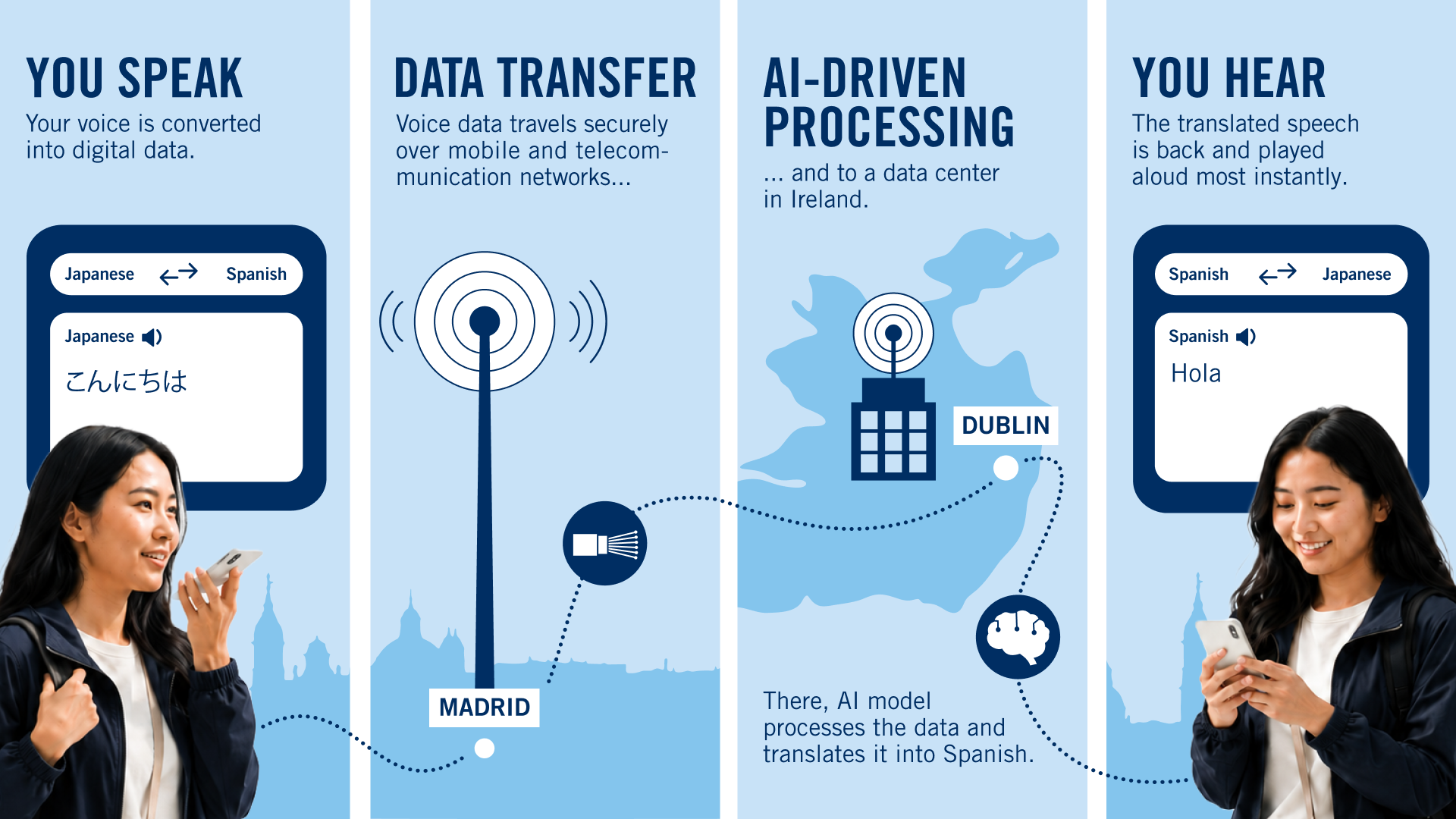
For users, it all happens in a fraction of a second. For data though, it travels thousands of kilometers before the translation appears on the screen. This is where optical fiber plays a quiet but essential role.
Comparable in size to a human hair, optical fibers are strands of glass that carry information as pulses of light between telecom hubs, internet exchange points, and data centers. Without this infrastructure, many of the digital services we rely on every day would simply not function.
Did you know?
Internet travels as light in glass fibers.
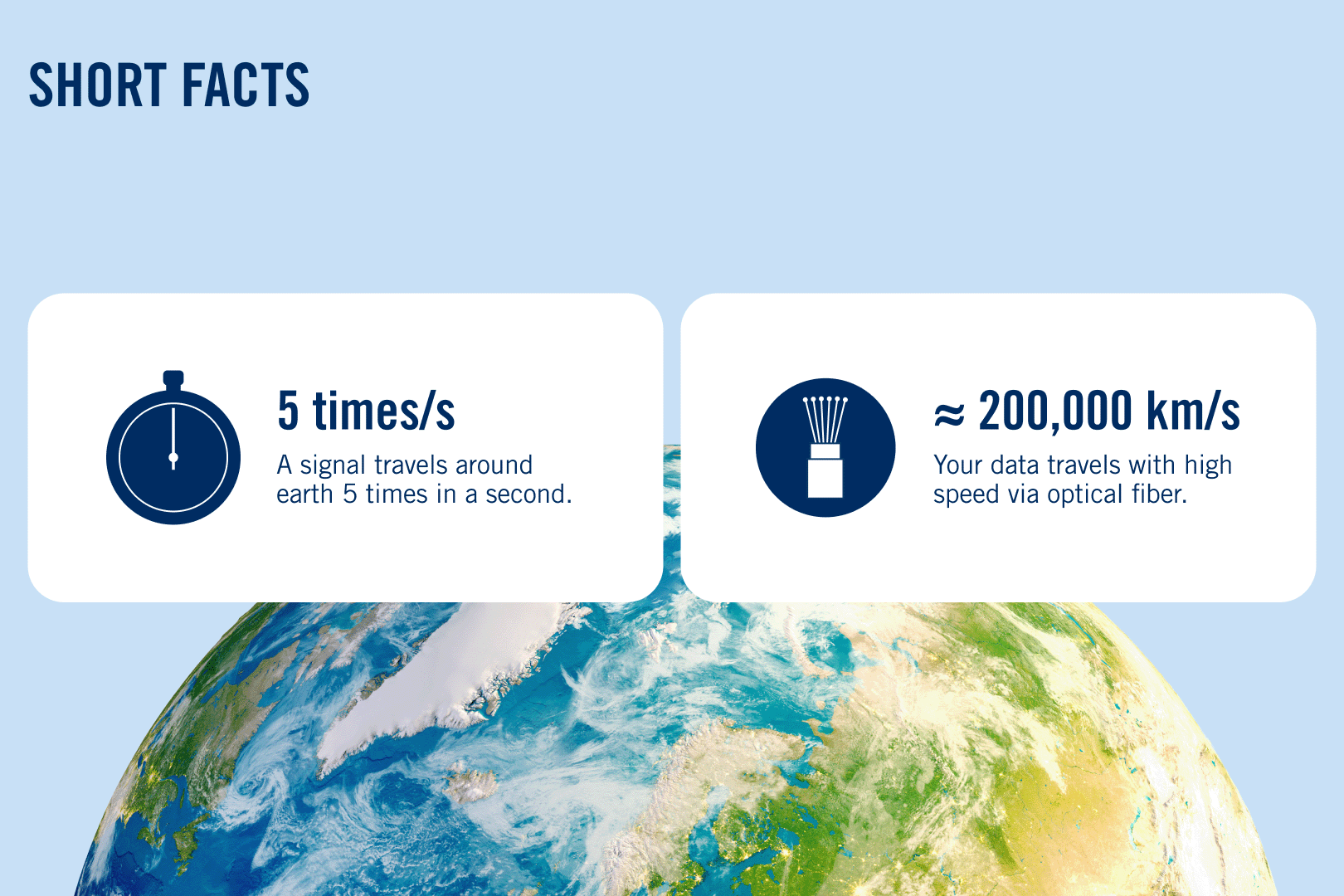
Inside an optical fiber, digital information is encoded into tiny flashes of laser light. The glass structure guides this light with remarkable efficiency, allowing it to travel long distances with minimal loss. Signals move through fiber at roughly two-thirds the speed of light in a vacuum — around 200,000 kilometers per second. To put that into perspective: at this speed, a signal travels around earth 5 times in a second.
Telecommunication and data communication: what's the difference?
Not all optical fibers serve the same purpose, and the distinction becomes increasingly important as data volumes continue to grow.
One major application is telecommunication. Optical fiber forms the global backbone of modern communications, connecting cities, countries, and continents through terrestrial and submarine networks before ultimately reaching the devices we use every day. When someone in Paris calls a colleague in Singapore, the signal travels through thousands of kilometers of optical fiber.

Another major application is data communication (datacom). Here, optical fiber is typically used over much shorter distances, primarily within and around data centers. The focus is on moving enormous volumes of data as quickly as possible. Optical fiber connects servers that continuously exchange information and, in some cases, links multiple data centers so they can operate together as if they were one giant computer. This is what enables cloud computing, AI workloads, and high-resolution video streaming with almost no noticeable delay.

The translation you triggered on your phone relies on both: long-distance telecom networks to move data around, and high-speed datacom connections to process it inside servers. Together, they form the layered infrastructure that powers the digital world.
However, while telecom networks span vast distances, the real explosion in data traffic is happening inside data centers. Artificial intelligence, cloud computing, and streaming services generate enormous amounts of data that must be processed and moved within confined spaces. As a result, datacom places particularly high demands on fiber performance — in terms of speed, capacity, and density.
Did you know?
Size doesn't determine capacity.
One hair-thin optical fiber can carry an astonishing amount of information. If every resident of London pressed "Play" on the same Netflix movie at exactly the same moment, a single optical fiber could carry all that data.
This is why advanced fiber technologies are becoming especially critical for datacom applications.
The material behind the network
Whether data travels across continents or within a single data center, the performance of optical fiber ultimately depends on one critical factor: the material it is made from.
At the heart of optical fiber lies a remarkably pure material: high-purity quartz glass.
For optical fiber, purity determines how far light can travel before it needs a boost. The purer the glass, the farther a light signal can travel without losing strength. In a standard telecom fiber, that distance is around 50 kilometers. By comparison, even in the clearest ocean water, you can usually only see about 20 meters before light fades from view.
Producing such ultra-pure material requires precise manufacturing and deep expertise in materials science.
The process begins with a cylinder-shaped preform — a scaled-up version of the fiber’s internal structure. This preform is then heated and drawn into an optical fiber just 125 micrometers thick, about the thickness of a human hair. From a single preform with an outer diameter of 200 mm and a length of 3 meters, more than 7,000 kilometers of single-mode fiber can be produced.

Basis for next generations
As new demands emerge — from AI-driven data processing to ever-growing global connectivity — the requirements for fiber performance continue to increase. Advanced concepts such as Hollow Core and Multicore fibers build on this material foundation, pushing the limits of what optical fibers can achieve.
We have worked with quartz glass for more than a century, developing materials used in industries ranging from semiconductors to aerospace. From the late 1960s, Heraeus played a key role in early optical fiber development, going on to supply quartz glass for Germany’s first test line in 1978. In 1991, we started to expand our market position and production capacity – helping build the digital infrastructure we rely on today. By now, almost 2 billion kilometers of optical fiber deployed world-wide are made from Heraeus quartz glass.
Today, we continue to build on this expertise, supporting the development of next-generation optical fiber technologies for increasingly data-intensive applications.
A new generation of optical fibers
As artificial intelligence, cloud computing, and video streaming expand, demand for data transmission continues to grow — especially inside data centers, where enormous volumes of information move constantly between servers. Thanks to optical fiber, several data centers can also work together as though they were one giant facility.
Global internet traffic has increased more than tenfold over the past decade, and data center workloads continue to grow rapidly. To keep thousands of servers working together, the internal network of a state-of-the-art data center can provide up to 13 petabits of bandwidth per second — the theoretical equivalent of moving around 140 exabytes of data per day, enough to transfer more than 9 billion full-length 4K movies. Looking ahead, technologies such as autonomous driving, industrial robotics, and immersive digital environments will require even faster and more reliable data exchange.
These environments require fibers that can carry more data, reduce delay, and fit into limited physical space.
One emerging technology is Hollow Core fiber.
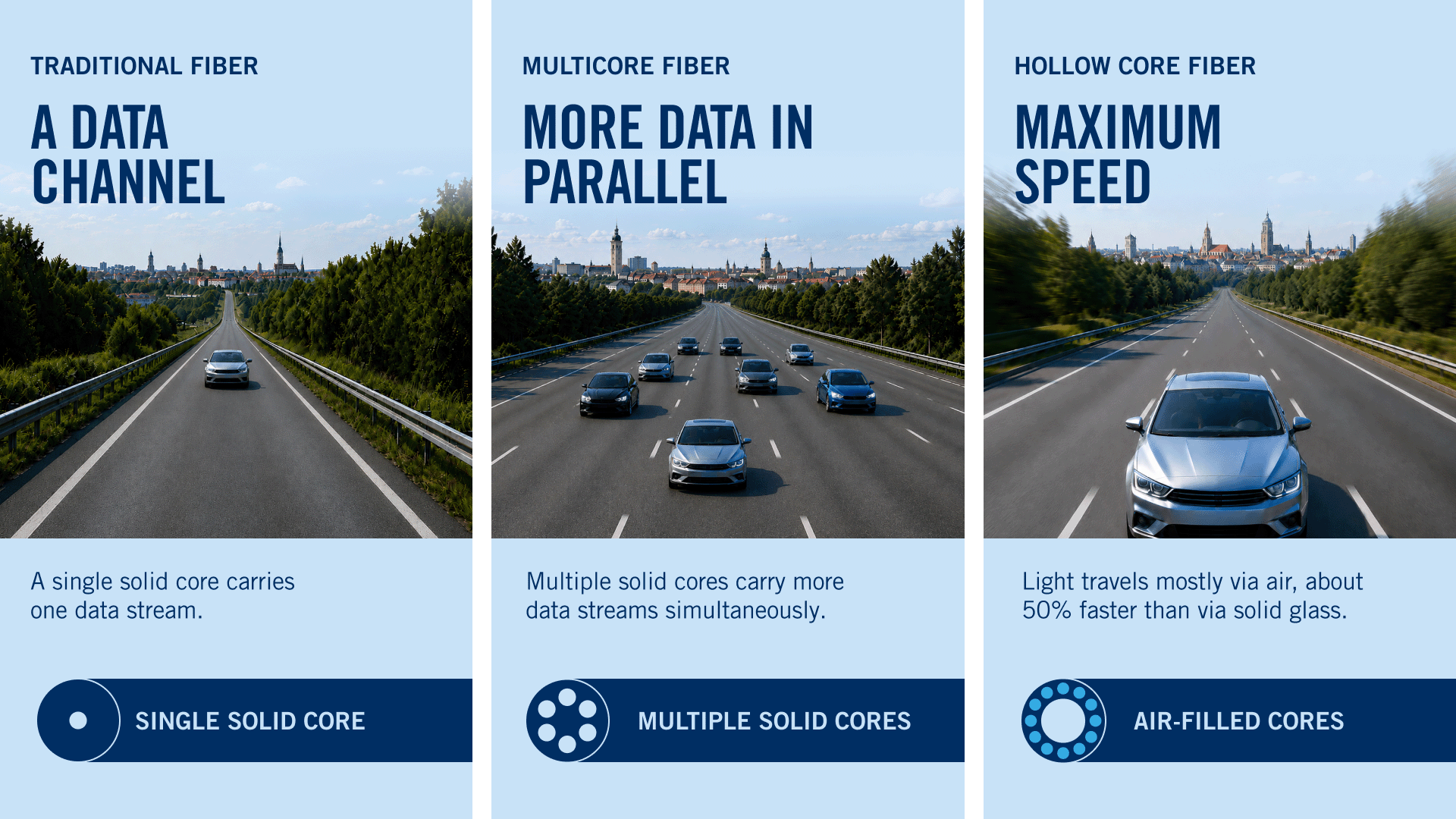
In conventional fibers, light travels through solid glass. Hollow Core fibers guide light through tiny air-filled channels.
Hollow Core fibers also offer additional advantages in bandwidth and lower signal attenuation, meaning they can transmit data with less loss and support higher capacity. This enables geographically distributed data centers to operate as one, giving companies greater freedom in where they build new facilities.
At the same time, manufacturing hollow-core fibers is highly complex. Precisely structuring microscopic air channels over long distances while maintaining mechanical stability and optical performance requires advanced materials expertise and extremely controlled production processes.
Multicore Fiber – More Capacity in the same space
Another emerging concept is Multicore fiber.
Traditional fibers contain a single light pathway. Multicore fibers integrate several independent light-guiding cores within the same strand of glass.
Multicore fibers increase transmission capacity by enabling multiple parallel data streams within a single fiber — essentially multiplying the amount of information that can be carried without increasing the physical footprint. This is particularly valuable in data centers, where space and scalability are critical constraints. However, manufacturing Multicore fibers is equally challenging.
The next chapter of global connectivity
As digitalization continues to accelerate, the demands on optical fiber infrastructure are growing. Applications are becoming more data-intensive, data centers are more powerful, and networks are more complex. At the same time, the materials that underpin this infrastructure must meet ever-higher performance requirements.
And as new technologies emerge, this invisible infrastructure will become even more critical. Future applications such as fully autonomous mobility, real-time digital twins of entire cities, or seamless human-machine interaction may depend on data speeds and capacities that today’s networks are only beginning to approach.
Without continued advances in optical fiber, many of these possibilities would remain out of reach. Just as today’s digital services rely on fiber to function, tomorrow’s innovations will depend on pushing its limits even further.